On This Page
Why SEO Traffic Without Conversions Is Wasted
There is a critical disconnect that we see in almost every eCommerce audit we perform: store owners invest heavily in SEO to drive organic traffic, celebrate ranking improvements and traffic growth, and then wonder why revenue has not grown proportionally. The answer is almost always a conversion problem, not a traffic problem. Ranking on page one of Google is meaningless if the visitors who arrive on your site leave without buying.
Consider the maths. A South African eCommerce store generating 20,000 organic visitors per month with a 1% conversion rate and an average order value of R850 produces R170,000 in monthly organic revenue. If that same store improves its conversion rate from 1% to 2.5% — without gaining a single additional visitor — monthly revenue jumps to R425,000. That is R255,000 in additional monthly revenue from the same traffic. No additional SEO spend, no new content, no link building. Just a better experience for the visitors you already have.
This is the core argument for eCommerce conversion optimization: it multiplies the return on every rand you spend acquiring traffic. SEO brings qualified visitors to your store. CRO turns those visitors into paying customers. Together, they create a revenue engine that compounds over time. Separately, you are either filling a leaking bucket or optimising a bucket that is empty.
Conversion Rate Impact
Same Traffic, 150% More Revenue
From: 1% conversion = R170,000/month
To: 2.5% conversion = R425,000/month
Without gaining a single additional visitor
CRO Before Traffic Growth
Revenue Reality Check: Before investing in more traffic, calculate your current conversion rate. If it is below 2%, you are almost certainly leaving more revenue on the table through conversion leaks than you could gain from ranking improvements. Fix the leaks first, then scale the traffic.
Understanding the eCommerce Conversion Funnel
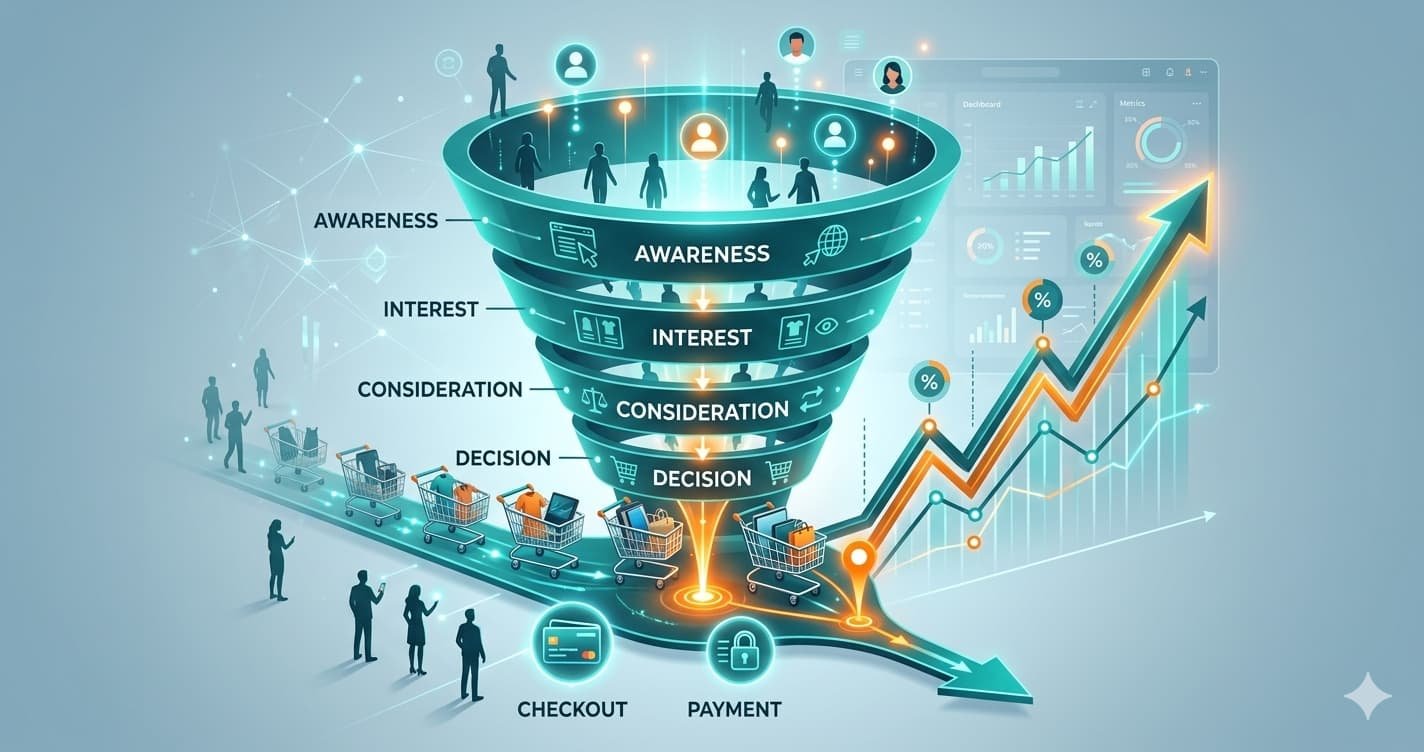
eCommerce conversion optimization requires understanding that a purchase is not a single decision — it is a series of micro-decisions that a visitor makes as they move through your site. Each stage of the funnel has distinct friction points, and each friction point is a potential exit. The stores that convert highest are the ones that systematically reduce friction at every stage rather than focusing on a single page or element.

The Four Stages of eCommerce Conversion
The eCommerce conversion funnel breaks down into four stages, each with its own optimisation priorities. The first stage is landing and orientation: the visitor arrives from Google, assesses whether the page matches their intent, and decides within 3 to 5 seconds whether to stay or bounce. The second stage is product evaluation: the visitor examines product details, images, reviews, pricing, and determines whether this specific product meets their needs. The third stage is purchase decision: the visitor decides to buy and adds the product to their cart, influenced by trust signals, urgency cues, and perceived value. The fourth stage is checkout completion: the visitor enters their information, selects shipping and payment, and completes the transaction — or abandons the cart entirely.
Each stage has a measurable drop-off rate, and the cumulative effect is significant. If 40% of visitors bounce at landing, 50% of remaining visitors leave during product evaluation, 60% of the remainder do not add to cart, and 70% of those who do add to cart abandon at checkout, your overall conversion rate is 0.6 x 0.5 x 0.4 x 0.3 = 3.6%. But improving each stage by just 10 percentage points transforms that equation dramatically. This is why CRO is a funnel-wide discipline, not a checkout-only fix.
Mapping Drop-Off Points With Data
Before optimising anything, you need to know where visitors are leaving. Google Analytics 4 provides funnel exploration reports that show exactly how many users move from page view to add-to-cart to checkout initiation to purchase completion. If 80% of your drop-off happens between product page view and add-to-cart, your product pages need work. If most users add to cart but abandon at checkout, your checkout flow is the bottleneck. Without this data, you are guessing — and guessing in CRO is expensive because every change you make has an opportunity cost.
Product Page Conversion Best Practices
The product page is where the majority of conversion battles are won or lost. It is the page that carries the heaviest burden: it must simultaneously satisfy the SEO requirements that got the visitor there, provide enough information for a purchase decision, build trust, create urgency, and make the path to checkout frictionless. A well-optimised product page does all of this without feeling cluttered or overwhelming.
Above-the-Fold Hierarchy
The content visible before scrolling — the above-the-fold area — determines whether a visitor engages further or bounces. On a product page, the above-the-fold hierarchy should present, in order of visual prominence: the primary product image (large, high-quality, zoomable), the product name and a short descriptive tagline, the price displayed clearly in ZAR with any discount or sale pricing shown as a crossed-out original price, availability status (in stock, limited stock, or out of stock), and the add-to-cart button in a high-contrast colour that stands out from the surrounding page elements.
Every element above the fold serves a conversion function. The image confirms "this is the right product." The name and tagline confirm relevance to the search query. The price addresses the most immediate question any buyer has. The availability status creates urgency or manages expectations. And the add-to-cart button provides a clear, immediate action path. Remove any element from this section that does not directly serve one of these functions — navigation breadcrumbs, promotional banners, and category links can all wait until below the fold.
Product Images That Convert
Product photography quality is one of the strongest predictors of eCommerce conversion rates. In our audits of South African online stores, we consistently find that stores with professional, multi-angle product photography convert 2 to 3 times higher than stores using manufacturer stock images or single low-quality photos. The minimum standard for a high-converting product page is five to eight images: a hero shot on a clean background, three to four angle shots showing different perspectives, one lifestyle or in-context image showing the product in use, and one detail shot highlighting key features, materials, or craftsmanship.
Image functionality matters as much as image quality. Implement zoom-on-hover so visitors can examine product details closely — this is especially important for apparel, jewellery, and electronics where texture, finish, and detail influence purchase decisions. On mobile, pinch-to-zoom must work smoothly. If your platform supports it, include a 360-degree view or short product video. Pages with video content convert up to 80% higher than pages without, according to multiple industry studies.
Product Descriptions That Sell
A product description optimised for conversions is fundamentally different from one optimised only for SEO. The SEO-focused description answers "what is this product and what keywords should it rank for." The conversion-focused description answers "why should I buy this product right now, from this store." The best product descriptions do both simultaneously by leading with benefits (what the product does for the buyer), supporting with features (the specifications that justify those benefits), and closing with differentiation (why this option is better than the alternatives).
For South African eCommerce stores, include locally relevant details that international competitors cannot match: delivery timeframes within South Africa, pricing in ZAR without currency conversion ambiguity, warranty and returns information specific to South African consumer protection laws, and any local certifications or standards compliance (SABS, NRCS). These details do not just build trust — they create a tangible advantage over international stores that ship to South Africa as an afterthought. For a deeper dive on structuring product pages for both rankings and conversions, see our guide on SEO for product pages.
South African Consumer Insight: In our experience with local eCommerce clients, South African shoppers are significantly more price-comparison-oriented than many international markets. Displaying competitive pricing clearly, offering price-match guarantees where feasible, and highlighting value propositions (free shipping over R500, bundle discounts, loyalty points) directly on the product page reduces the likelihood of a visitor leaving to compare prices elsewhere.
Trust Signals That Drive Purchases
Trust is the invisible conversion factor. A visitor can love your product, accept your price, and still abandon the purchase because they do not trust your store enough to enter their credit card details. This is particularly acute in South Africa, where online fraud awareness is high and consumers have been conditioned to be cautious by well-publicised scam incidents. Building trust on your eCommerce store is not optional — it is a conversion requirement.

Essential Trust Elements for South African eCommerce
The trust signals that South African online shoppers respond to most strongly are, in order of impact: SSL certificate and visible security indicators — the padlock icon and "https" in the URL bar are table stakes, but explicitly displaying "Secure Checkout" badges near the add-to-cart and payment buttons reinforces the message. Customer reviews and ratings — authentic, verified purchase reviews with customer names and dates are the most powerful trust signal available, outperforming every other element in A/B tests. Clear returns and refund policy — South African consumers want to know they can return a product before they commit to buying it; display a summary of your returns policy directly on the product page, not buried in a footer link.
Recognised payment method logos — display Visa, Mastercard, PayFast, SnapScan, Ozow, and any buy-now-pay-later options (Payflex, Mobicred) prominently near the purchase button. South African shoppers associate these logos with security and legitimacy. Physical business presence — display a South African phone number, physical address, and business registration number in your footer and on your contact page. Anonymous online stores without visible local presence convert significantly lower than stores that demonstrate they are a real, reachable South African business.
Social Proof Beyond Reviews
Reviews are the foundation of social proof, but they are not the only tool available. Display real-time or recent purchase notifications ("Thabo from Johannesburg purchased this item 2 hours ago") to create social validation and subtle urgency. Show the number of people currently viewing a product if your platform supports it. Feature user-generated content — customer photos of your products in use — alongside professional photography. Include any media mentions, awards, or industry recognition your brand has received. Each of these signals reinforces the same message: other people trust this store and buy from it, so it is safe for you to do the same.
Checkout Optimization: Reducing Cart Abandonment
Cart abandonment is the single largest revenue leak in eCommerce. The average cart abandonment rate globally sits at approximately 70%, and South African stores tend to experience rates between 70% and 78% depending on the industry and payment options available. This means that for every 10 visitors who add a product to their cart, only 2 to 3 actually complete the purchase. The remaining 7 to 8 visitors had enough purchase intent to select a product but encountered enough friction in the checkout process to walk away. Fixing checkout friction is the highest-ROI conversion optimization you can undertake.
The Guest Checkout Imperative
Forcing account creation before purchase is the number one cause of cart abandonment across every industry and market. Approximately 24% of cart abandonments are directly attributable to mandatory account creation. The solution is straightforward: offer guest checkout as the default option, with account creation presented as an optional step after purchase completion. You can still capture the customer's email address (which you need for order confirmation anyway) and offer account creation as a post-purchase convenience: "Want to track your order and check out faster next time? Create an account in one click."
Transparent Pricing and Shipping
Unexpected costs at checkout — shipping fees, VAT additions, handling charges — are the second largest abandonment driver, accounting for roughly 18% of abandonments. South African consumers are especially sensitive to this because many international stores display prices excluding VAT and add shipping costs only at the final checkout step. Your product pages should display the full price inclusive of VAT (which is the legal requirement in South Africa under the Consumer Protection Act), and shipping costs should be visible or calculable before the checkout process begins. If you offer free shipping above a threshold (a proven conversion tactic), display that threshold prominently: "Free delivery on orders over R750."
Streamlined Checkout Flow
The optimal eCommerce checkout has three steps or fewer: shipping information, payment selection, and order confirmation. Every additional step, page load, or form field you add increases the probability of abandonment. Implement address auto-complete for South African addresses to reduce form friction. Pre-select the most common shipping option. Auto-detect the card type from the first four digits. Use inline validation on form fields so errors are caught immediately rather than after form submission. These micro-optimisations feel minor individually but their cumulative effect on completion rates is substantial — we have seen checkout completion rates improve by 15% to 25% through form optimisation alone.
Payment Method Diversity
South African consumers have strong payment method preferences, and offering only credit card payments excludes a significant portion of your potential customers. A conversion-optimised South African checkout should offer: credit and debit card payments via a trusted gateway, instant EFT through PayFast or Ozow, SnapScan for mobile-first buyers, buy-now-pay-later options like Payflex or Mobicred for higher-value purchases, and manual EFT as a fallback for customers who prefer bank transfers. Each additional relevant payment method you add captures a segment of customers who would otherwise abandon because their preferred payment method was not available.
Cart Recovery Revenue: Implement an automated cart abandonment email sequence: first email within 1 hour of abandonment (reminder with cart contents), second email at 24 hours (include social proof or a customer review), third email at 72 hours (offer a small incentive like free shipping or 5% discount). This three-email sequence typically recovers 5% to 15% of abandoned carts — pure revenue that would otherwise be lost entirely.
Mobile Conversion Optimization
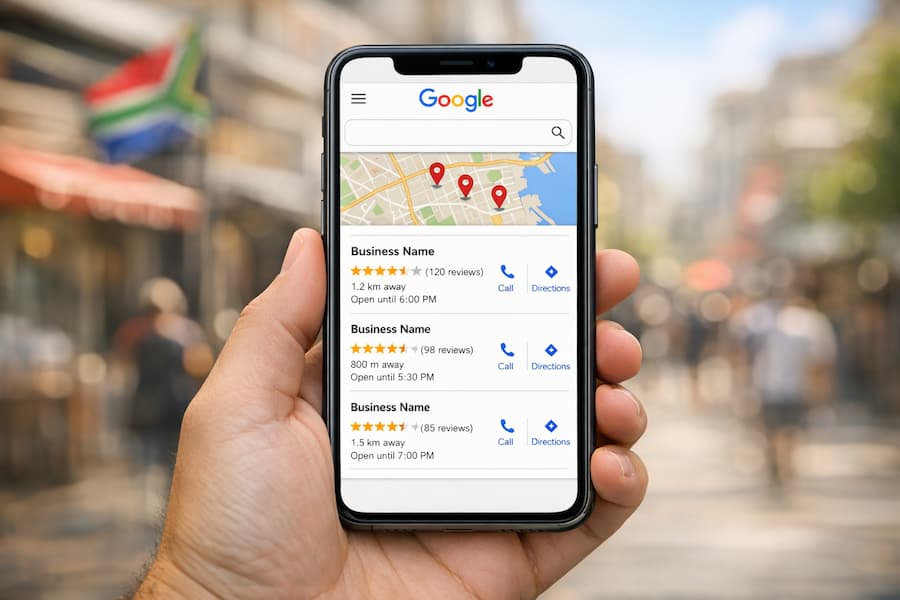
Mobile commerce accounts for over 60% of eCommerce traffic in South Africa, driven by high smartphone penetration and increasing mobile data affordability. Yet mobile conversion rates consistently lag behind desktop by 50% or more across most South African online stores. The gap is not caused by lower purchase intent on mobile — it is caused by poor mobile shopping experiences. Closing this gap represents the single largest conversion opportunity for most eCommerce businesses.
Mobile-Specific UX Requirements
Mobile eCommerce optimization is not simply "making the desktop site responsive." Mobile users interact with your store differently: they scroll vertically with their thumb, they cannot hover over elements, they have limited screen real estate, and they are more likely to be interrupted during a session. Effective mobile conversion optimization addresses these realities directly. Buttons must be at least 48 pixels tall with adequate spacing to prevent mis-taps. The add-to-cart button should be sticky — remaining visible as the user scrolls through product details. Product image galleries should use horizontal swipe navigation, not thumbnail grids. Form inputs should trigger the appropriate mobile keyboard (numeric keyboard for phone numbers and card numbers, email keyboard for email fields).
Mobile Page Speed Is Non-Negotiable
Mobile users on South African networks experience variable connection speeds, and the tolerance for slow pages is extremely low. Over 53% of mobile visitors will abandon a page that takes longer than 3 seconds to load. For eCommerce product pages, which are typically image-heavy, achieving fast mobile load times requires aggressive image optimization (WebP format, responsive images, lazy loading below the fold), minimal JavaScript blocking the critical rendering path, and efficient use of browser caching. Your target should be a Largest Contentful Paint (LCP) under 2.5 seconds on a mid-range mobile device over a 4G connection. For a comprehensive approach to speed optimization and its impact on rankings, see our detailed guide on page speed and SEO.
Mobile Payment Integration
The mobile checkout experience deserves special attention. On mobile, typing long card numbers and billing addresses is significantly more frustrating than on desktop. Integrate Apple Pay, Google Pay, and SnapScan to allow one-tap or scan-to-pay mobile purchases that bypass the traditional checkout form entirely. For South African stores, SnapScan integration is particularly valuable — the user simply scans a QR code and approves the payment in their banking app, eliminating all form friction. Stores that add express mobile payment options typically see mobile conversion rates increase by 20% to 35%.
Using Data to Improve Conversions (Analytics Setup)
Conversion optimization without data is guesswork. Effective CRO requires a measurement foundation that tracks user behaviour at every stage of the funnel, identifies where visitors drop off, and quantifies the impact of changes you make. The good news is that the essential tools are free. The challenge is configuring them correctly so they capture the data you actually need for decision-making.
Essential Google Analytics 4 eCommerce Events
GA4's enhanced eCommerce tracking provides the event framework you need. At minimum, configure these events: view_item (product page views), add_to_cart (items added to cart), begin_checkout (checkout initiated), add_shipping_info (shipping step completed), add_payment_info (payment step completed), and purchase (transaction completed). With these events firing correctly, you can build funnel reports that show exactly where users drop off and calculate conversion rates at each stage. Without them, you have aggregate traffic and revenue numbers but no diagnostic insight into why your conversion rate is what it is.
Heatmaps and Session Recordings
Quantitative data tells you what is happening; qualitative data tells you why. Heatmap tools like Hotjar or Microsoft Clarity (which is free) record where visitors click, how far they scroll, and what elements they interact with on your product pages. Session recordings show you actual user journeys — you can watch a visitor land on a product page, scroll past the reviews, hesitate at the price, and then leave. These recordings surface friction points and confusion that no amount of analytics data would reveal. Review 20 to 30 session recordings per week, focusing on sessions where users added to cart but did not purchase, and you will identify actionable conversion issues within the first week.
A/B Testing Framework
Once you have identified a potential conversion issue and developed a hypothesis for fixing it, A/B testing is how you validate that your fix actually works before rolling it out permanently. Run controlled experiments where 50% of traffic sees the original version (control) and 50% sees your variation. Measure the conversion rate difference with statistical significance — typically requiring at least 200 to 400 conversions per variation to draw reliable conclusions. For South African eCommerce stores with moderate traffic, this means each test may need to run for 2 to 4 weeks to reach significance. Prioritise tests with the highest potential impact: add-to-cart button placement and colour, product page layout changes, checkout flow modifications, and pricing display formats. For ensuring your testing does not inadvertently harm your technical SEO setup, refer to our technical SEO checklist.
The SEO-CRO Feedback Loop
SEO and CRO are not separate disciplines that happen to coexist on the same website — they are interdependent systems that directly influence each other's performance. Understanding this feedback loop is essential for maximising the return on both investments simultaneously rather than optimising one at the expense of the other.
How CRO Improvements Boost SEO
Google's ranking algorithm incorporates user engagement signals as quality indicators. When you improve your conversion rate, you simultaneously improve several metrics that Google tracks: time on page increases because visitors are engaging with product content rather than bouncing, pages per session increases because converting visitors browse more products, bounce rate decreases because the landing experience satisfies the search intent, and click-through rate from search results improves as your brand reputation grows through positive shopping experiences. These engagement improvements send positive quality signals to Google, which reinforces and gradually improves your organic rankings — creating a virtuous cycle where better conversions lead to better rankings, which lead to more traffic, which generates more conversions.
How SEO Strategy Informs CRO Priorities
Your SEO data reveals which product pages receive the most organic traffic, which search queries drive visitors to your store, and what intent those visitors carry when they arrive. This data is invaluable for CRO prioritisation. A product page receiving 5,000 organic visits per month with a 0.8% conversion rate is a higher-priority CRO target than a page receiving 200 visits with a 3% conversion rate — the absolute revenue opportunity is far larger. Similarly, understanding the search queries that drive traffic to a page tells you what the visitor expects to find, which directly informs how you should structure the page content, imagery, and calls to action to match that expectation.
Aligning Content With Purchase Intent
The most powerful intersection of SEO and CRO is intent alignment. When a visitor searches "buy Samsung Galaxy S25 Ultra Johannesburg" and lands on your product page, the page must immediately confirm that the visitor has found exactly what they searched for — the right product, available for purchase, deliverable to their location, at a competitive price. Every element of the page should reinforce this alignment. If the page instead opens with a lengthy brand history or requires three clicks to find the price, you have broken the intent-to-conversion bridge. Audit your top 20 organic landing pages and evaluate whether the above-the-fold content on each page directly addresses the primary search intent that drives traffic to it. Where it does not, realign the page hierarchy to match visitor expectations.
The Compound Effect: A South African eCommerce client of ours implemented SEO and CRO improvements in parallel over 12 months. Organic traffic grew by 140% through SEO while conversion rate improved from 1.2% to 2.8% through CRO. The combined effect was a 530% increase in organic revenue — neither discipline alone could have achieved that result. This is the compound power of treating SEO and CRO as a unified growth strategy rather than separate projects.
Frequently Asked Questions
The average eCommerce conversion rate in South Africa sits between 1% and 2%, slightly below the global average of 2% to 3%. Well-optimised South African stores regularly achieve 3% to 5%. The variance depends on industry, traffic quality, and user experience. Fashion stores tend to convert at 1% to 2%, while niche specialist stores with high-intent organic traffic can reach 5% or higher. Focus on your trajectory — consistent, data-driven improvements compounding over time — rather than comparing your absolute rate to industry averages.
Page speed has a direct, measurable impact on conversions. Each additional second of load time reduces conversions by 7% to 12%. For a South African store doing R500,000 per month, a 2-second improvement could translate to R70,000 to R120,000 in additional monthly revenue. Over 53% of mobile visitors abandon pages that take longer than 3 seconds to load. Optimising Core Web Vitals improves both Google rankings and conversion rates simultaneously.
South African shoppers respond strongly to SSL certificates and visible security badges, clear returns and refund policies displayed before checkout, local contact information including a South African phone number and physical address, payment method logos for trusted local options like PayFast, SnapScan, and Ozow, and verified customer reviews with photos. Displaying your business registration number and industry certifications also builds confidence with local buyers who are cautious about online fraud.
Cart abandonment in South Africa averages 70% to 75%. The most impactful strategies are: offering guest checkout (forced account creation is the top abandonment cause), displaying all costs including shipping and VAT upfront, providing multiple payment options including EFT, credit card, and buy-now-pay-later, simplifying checkout to three steps or fewer, implementing cart recovery emails within one hour of abandonment, and ensuring your checkout is fully optimised for mobile devices.
If your store receives meaningful traffic (500+ sessions per month) but converts below 1.5%, prioritise CRO first — you are leaking revenue from traffic you have already earned. If traffic is low, SEO should come first because CRO on a low-traffic site produces statistically insignificant results. The ideal approach is parallel investment: build traffic through SEO while optimising conversion paths so every new visitor has the highest possible chance of becoming a customer.