
What Is AI Search and How Does It Work?
The way South Africans search for businesses is changing right now, and most business owners don't realise it yet.
For 25 years, Google has shown us a list of 10 blue links. Click one, scroll the page, find your answer. That's changing. Google's AI is now generating answers directly in the search results—synthesising information from multiple sources and presenting it as a single coherent response. And that response doesn't always link to the #1 ranking website.
Google AI Overviews now appear in approximately 50% of all search queries. That means half of all searches—every second search your customer makes—are seeing AI-generated answers instead of traditional rankings.
But Google isn't alone. ChatGPT, Microsoft Copilot, Perplexity, and Google Gemini are all using Retrieval-Augmented Generation (RAG) to answer questions. Here's how RAG works in plain English: the AI searches the web, retrieves relevant sources, and then generates a new answer, citing those sources as it goes.
The key difference: AI queries are longer (averaging 23 words vs. 4 words on traditional Google) and sessions last longer (6 minutes average vs. seconds on Google). Users are having conversations with AI. And if your business isn't part of that conversation, you don't exist to those customers.
Key Insight: The overlap between Google's top-ranked pages and pages cited in AI Overviews has dropped below 20%. Ranking #1 on Google no longer guarantees AI visibility. They're different ranking systems with different rules.
The Numbers: Why AI Search Matters Right Now
Data tells the story. And the story is urgent.
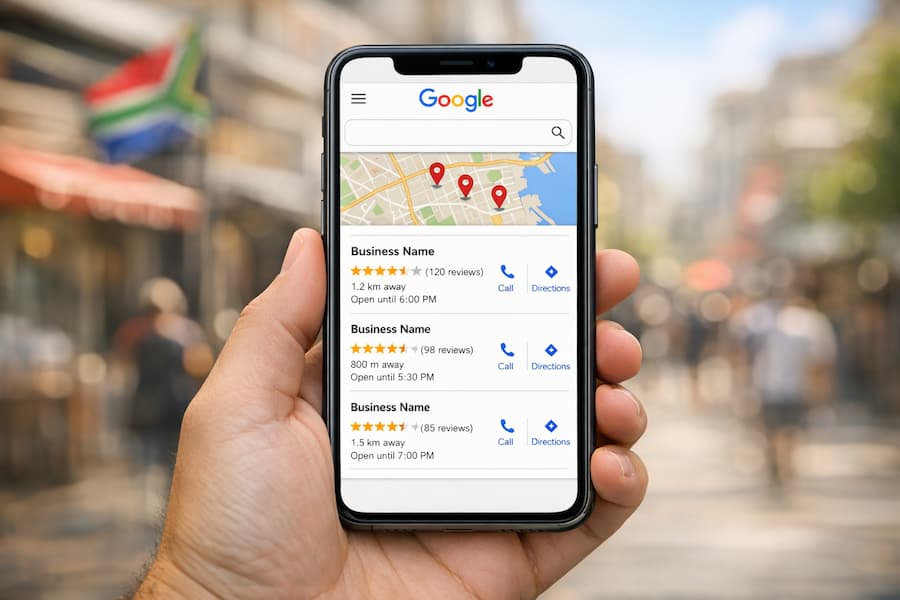
50% of Google searches trigger AI Overviews. That's not a future projection. That's happening now, in 2026, on your customers' phones.
AI Overviews have grown 58% year-over-year in presence across industries. The trend isn't slowing—it's accelerating.
Here's what should catch your attention: Pages cited in AI Overviews see an average 18% increase in click-through rate compared to traditional organic rankings. Being in the AI answer isn't a loss. It's actually more valuable than being ranked #1 on Google in many cases.
But there's a flip side: 58% of Google searches now result in zero clicks. If your business isn't in that AI answer, the user never finds you. They get their answer from someone else's content.
Gartner projects that overall organic click-through rates will decline 25% by 2026 due to AI-assisted search. That means even if you maintain your rankings, you'll see fewer clicks unless you're also visible in AI responses.
And here's the kicker: 85% of brand mentions in AI responses come from third-party pages, not the brand's own domain. If a journalist writes about your business, or a review site mentions you—that citation is more valuable now than your own content. Reputation and third-party endorsements matter more than ever.
Pro Tip: 63% of businesses reported Google AI Overviews positively impacted their organic traffic and visibility. Early movers benefit most. The businesses optimising now are capturing the growth.
What Is GEO (Generative Engine Optimisation)?
If SEO is about ranking in a list of 10 blue links, GEO is about being cited in an AI-generated answer.

GEO stands for Generative Engine Optimisation. It's the practice of optimising your content, website, and online presence so that AI platforms cite, recommend, or mention your business when answering user queries.
Read more about mastering generative engine optimisation in 2026 on Search Engine Land, a detailed guide from one of the industry's most respected sources.
GEO builds on SEO—it doesn't replace it. Strong traditional SEO (site speed, mobile responsiveness, clean site structure, quality content) is the foundation. GEO is the next layer. If your site isn't accessible or readable, no AI system will cite you.
One critical concept: Entity Reinforcement. AI systems build confidence about who you are when they see consistent information about your business across multiple independent sources. When your name, business type, location, and services are described the same way on your website, Google Business Profile, industry directories, and social media—AI systems treat you as a credible entity. Inconsistency erodes that trust.
NexusSEO specialises in GEO and AI Search optimisation. We’ve been tracking these shifts closely and helping South African businesses prepare for this reality. For the latest developments, read our coverage of what Google announced at I/O 2026—AI Mode hit 1 billion users and search agents arrived.
5 Things Your South African Business Can Do Today
You don't need to wait for perfect conditions to start optimising for AI search. Here are five immediate actions:

5 Immediate AI Search Actions
1. Check If AI Bots Can Actually Crawl Your Site
Cloudflare recently changed its default settings to block AI bots (ChatGPT-User, GPTBot, Googlebot-Extended, and others). If your site uses Cloudflare—and many South African sites do—you may have unknowingly blocked AI systems from accessing your content. Check your Cloudflare settings or server logs for "ChatGPT-User" requests. If they're being blocked, fix it. You want AI systems to be able to read your pages.
2. Add Structured Data / Schema Markup
JSON-LD schema markup increases AI citation rates by 3.1×. Structured data tells AI systems exactly what you do, who you are, and where you are. This is non-negotiable.
Priority schemas for your business:
- Article (for blog posts)
- LocalBusiness or Organization (for your main business)
- FAQPage (for FAQ sections)
- Product or Service (if you sell products/services)
Technical SEO—our core service—covers schema implementation and site architecture. This is foundational work that enables everything else.
3. Structure Content for AI Extraction
AI systems don't read your page the way humans do. They extract self-contained passages and passages that directly answer questions.
What this means:
- Put direct answers in the first 200 words of every page
- Use clear, descriptive headings (H2 and H3)
- Define terms upfront: "SEO (Search Engine Optimisation) is the process of..."
- Answer the question in one paragraph before diving into detail
Content with definition-lead sentences increases AI extraction probability by 2.8×. Start your key sections by defining what you're talking about.
4. Build Consistent Entity Signals Across the Web
Your business name, address, and phone number (NAP) should be identical across:
- Your website
- Google Business Profile
- Business directories (Brabys, SA Yellow, YellowSA)
- Social media (LinkedIn, Facebook, Instagram)
- Review sites (Trustpilot, Google Reviews)
AI systems cross-reference these sources. Consistency = credibility. Inconsistency = confusion and lower visibility.
5. Keep Content Fresh
AI has a strong recency bias. Content older than 3 months sees sharp drops in AI citations. Update your key pages quarterly at minimum. This is especially critical for advice, guides, statistics, and news-related content.
For a blog post like this, updating quarterly keeps it relevant and signals to AI systems that your information is current.
Ready to Optimise for AI Search?
AI search is reshaping the digital landscape. Businesses that act now will dominate their markets. Get a free assessment of your AI search readiness and a roadmap to visibility.
Get Your Free AI Search Audit →Why South African Businesses Have a Unique Advantage (And Risk)
Here's something most South African business owners don't realise: the GEO space is nearly empty right now. While international businesses are scrambling to optimise for AI search, most SA businesses haven't even heard of GEO.
That's an opportunity. The first movers—businesses that understand this shift and act on it—will dominate their categories before competitors wake up.
Second advantage: South Africa's mobile-first internet behaviour means more conversational and voice queries. Voice queries are longer, more natural, and they trigger AI Overviews more frequently. Your customers are already using these platforms. You just need to show up.
Third: Local businesses with strong Google Business Profiles and consistent citations are already halfway there. They have the foundation. They just need to layer in GEO-specific optimisation.
The risk? If your competitors start optimising for AI search and you don't, the gap will become very hard to close. AI visibility, like traditional SEO, has compounding effects. Early visibility builds momentum.
Frequently Asked Questions
What is Google AI Overview?
Google AI Overview is an AI-generated summary that appears at the top of Google search results. Instead of showing a list of 10 blue links, Google's AI synthesises answers from multiple sources and presents them as a single answer. It's now appearing in approximately 50% of all Google search queries.
What is GEO (Generative Engine Optimisation)?
Generative Engine Optimisation (GEO) is the practice of optimising your content and online presence so that AI platforms cite, recommend, or mention your business in AI-generated answers. Unlike traditional SEO (which aims to rank in search results), GEO focuses on being included in AI responses.
Does my South African business need GEO?
Yes, if you want to remain visible as search increasingly shifts toward AI-generated answers. While traditional SEO is still critical, ignoring GEO means your business may not appear in AI-powered searches—and customers are already using these platforms.
Is traditional SEO still important if AI search is growing?
Absolutely. GEO builds on SEO. Strong traditional SEO fundamentals—quality content, mobile responsiveness, site speed, and structured data—form the foundation for AI visibility. The two work together, not in competition.