
On This Page
Why Local eCommerce SEO is Different in South Africa
South African eCommerce SEO requires a fundamentally different approach than international strategies. The local market has unique dynamics: ZAR pricing, high shipping costs relative to product value, intense regional competition, and distinct buyer behavior. While global eCommerce SEO focuses on international shipping and multi-currency strategies, South African stores must optimise for local buyers, regional keywords, and hyperlocal search signals to rank effectively and drive conversions.
The South African eCommerce landscape is fundamentally different from mature Western markets like the US or UK. Our market is younger, smaller in volume, but growing rapidly. A typical South African online store competes against both established local retailers and international players shipping into the country. The market's unique characteristics—from payment method preferences (EFTs and COD still dominate) to courier reliability concerns to regional buying behavior—shape how customers search and convert. What works for a US eCommerce store optimising for nationwide shipping doesn't translate directly to a Durban-based retailer selling within South Africa.
Many eCommerce store owners make the mistake of applying global best practices directly to their South African operations. This approach consistently fails because the cost structures, buyer expectations, and search intent are completely different. International SEO strategies often assume cheap shipping as a competitive advantage; in South Africa, shipping costs frequently exceed the product's margin, forcing retailers to bundle shipping into product pricing or offer free shipping at higher minimum order values. Google knows this. When a South African customer searches for "buy laptops online," they're searching with different intent than a UK buyer—local availability, ZAR pricing, and reliable delivery matter more than international options. International competitors using global keyword research miss these nuances entirely.
Local eCommerce SEO isn't just about adding "South Africa" to your keywords. It requires understanding how Google recognises local relevance for online stores. This means optimising your technical SEO for regional signals, building local citations beyond Google Business Profile, targeting keywords that reflect South African buyer intent, and structuring your content to address regional objections (courier costs, delivery timeframes, payment options). A store optimising for local SEO for eCommerce in South Africa needs to think about regional competition intensity, local shipping partners like Takealot and Loot, and how Google understands your geographic service area.
This is why a proper eCommerce SEO audit is the first step for South African stores looking to dominate local search. The framework we've developed over 18+ years of optimising South African eCommerce stores addresses these regional challenges head-on. Rather than forcing international templates onto a local market, we work backwards from South African buyer behaviour, regional keywords, and local competition patterns to build a ranking strategy that actually works for your store.
Step 1: Technical SEO Foundation for South African Stores
Technical SEO is the foundation of any successful eCommerce ranking strategy. South African online stores must ensure fast page load times (especially critical for mobile-first indexing), secure HTTPS connections, crawlable site architecture, and proper site structure. Without these technical basics in place, no amount of content optimization or link building will help your store rank for local eCommerce keywords or convert visitors into customers.

You cannot build a successful eCommerce SEO strategy on a broken technical foundation. Think of technical SEO as the plumbing in your house—you don't notice it until it's broken, but when it is, everything else fails. For South African stores, this is even more critical because many customers browse on slower 4G connections, and Google's mobile-first indexing means mobile speed directly impacts rankings.
The core technical factors that matter most for South African eCommerce stores are:
- Page Speed: Mobile pages must load in under 3 seconds. Use tools like PageSpeed Insights to identify slowdowns. Image optimization, lazy loading, and hosting quality matter significantly.
- Mobile Optimization: With 70%+ of South African eCommerce traffic on mobile, your store must be fully responsive and touch-friendly. Desktop-only optimization is career suicide for eCommerce.
- HTTPS Security: All pages must be secure. Google ranks HTTPS sites higher, and customers won't buy from sites that trigger security warnings.
- Crawlable Site Architecture: Google must be able to find all important product pages. Fix crawl errors, remove redirect chains, and ensure your XML sitemap is accurate.
- Structured Data: Product schema, review schema, and breadcrumb schema help Google understand your content and display rich snippets in search results.
Many South African eCommerce stores overlook technical SEO because they're focused on content and links. A comprehensive technical SEO audit often uncovers critical issues that are holding back rankings and conversions—sometimes fixing these alone can double your organic traffic within months.
Step 2: Local Signal Optimization
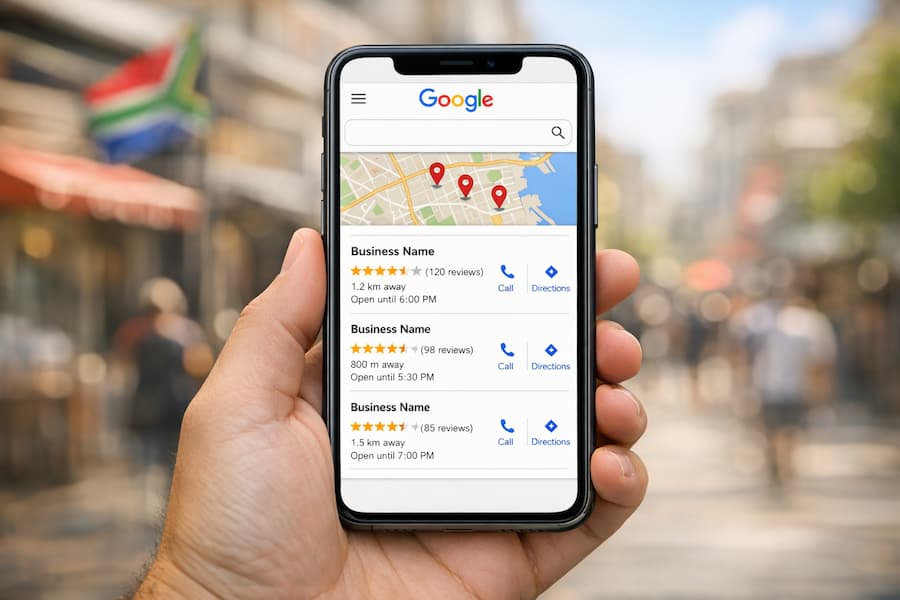
Local search signals directly impact your ability to rank for "near me" searches and location-specific eCommerce queries. Google My Business optimization, consistent NAP (Name, Address, Phone) across local citations, location pages, and reviews are critical ranking factors. For South African eCommerce stores, strong local signals differentiate you from international competitors and help Google understand you serve local customers effectively.
One question we hear frequently from eCommerce store owners is: "Does Google My Business actually help eCommerce stores rank better locally in South Africa?" The answer is a resounding yes. GBP optimization is one of the fastest ways to improve your visibility in local search results and attract nearby customers looking for products you sell.
Here's what matters most for local signal optimization in the South African context:
- Google My Business: Claim and fully optimize your GBP profile. Fill every field, add accurate address (even if it's a warehouse), include business hours, and post regularly. Add high-quality photos of your store, products, and team.
- Local Citations: Build consistent NAP (Name, Address, Phone) listings on South African business directories, review sites, and local industry databases. Consistency across citations sends strong local signals to Google.
- Location Pages: If you serve multiple areas (Johannesburg, Cape Town, Durban, Pretoria), create dedicated location pages with local keywords and local content. These pages help you rank for location-specific searches like "eCommerce fulfillment Johannesburg".
- Reviews: Encourage customers to leave reviews on Google and other platforms. Reviews are both ranking factors and trust signals that influence buying decisions.
- Local Backlinks: Get linked from South African news sites, business directories, and local authority websites. These local links carry extra weight for local search.
The combination of a well-optimized GBP profile, consistent citations, and strong reviews creates a "local authority" signal that tells Google your store is a trusted local business. This directly translates to higher rankings for location-specific searches and more customers finding you when they search for products in their area.
Step 3: Keyword Strategy for South African eCommerce
Effective keyword strategy for South African eCommerce requires understanding your local market's unique search behavior. You'll need to identify high-intent keywords with buyer intent (product keywords, price comparisons, local modifiers), target long-tail keywords where competition is lower, and incorporate regional keywords. ZAR pricing terms, regional search modifiers, and local buyer language differentiate winning eCommerce keyword strategies from generic, global approaches.

The most common question from eCommerce store owners is: "How do I optimize my eCommerce store for local Google search results in South Africa?" The answer starts with keyword research. You need to understand what your target customers are actually searching for, not just what you think they should search for.
Here's your keyword strategy framework for South African eCommerce:
- Identify Buyer Intent Keywords: These are high-intent keywords where customers are ready to buy. Examples: "buy running shoes South Africa", "women's handbags online ZA", "laptop prices Johannesburg". Target these for conversions.
- Long-Tail Opportunities: These have lower competition and higher intent. Examples: "affordable winter boots for women South Africa", "best waterproof phone case under R500". These convert better than short-tail keywords.
- Local Modifiers: Add city names, region names, and "near me" variations. Examples: "shoe store near me", "electronics delivery Durban", "furniture Pretoria fast delivery".
- ZAR Pricing Keywords: South African customers search with prices in rand. Target keywords like "laptops under R10000", "sneakers R300-R500", "TVs between R5000 and R15000".
- Competitive Analysis: Study what keywords your competitors rank for. Use SEO tools to identify ranking gaps—keywords they don't target where you can win.
The key insight: South African customers don't search the same way Americans or Europeans do. They search with ZAR prices, use local modifiers, and often include delivery keywords ("fast delivery", "cash on delivery", "EFT payment"). Your keyword strategy must reflect this local search behavior, not copy global best practices.
Step 4: Content Hierarchy & Internal Linking
Site architecture and internal linking directly impact how Google crawls and ranks your eCommerce store. A proper pillar page structure (broad pillar topics with narrow cluster content) combined with strategic internal linking helps search engines understand your site's topical authority. For eCommerce stores, effective internal linking between product categories, related products, and supporting content increases page authority and distributes ranking power to your most important pages.
The proper internal linking structure is what separates well-optimized eCommerce stores from those that struggle to rank. Most stores make the mistake of treating internal linking as an afterthought, when in reality, it's one of your highest-leverage ranking factors.
Here's how to structure your eCommerce site for maximum ranking power:
- Pillar Pages: Create broad pillar pages for main product categories (e.g., "Women's Running Shoes," "Laptop Computers"). These pages link to cluster content (specific product types, detailed guides) that cover subtopics.
- Cluster Content: Write detailed guides and comparison posts that link back to the pillar page. For example, from "Best Winter Running Shoes 2026" link back to "Women's Running Shoes."
- Anchor Text Strategy: Use descriptive anchor text that tells Google what the linked page is about. Instead of "click here," use "best budget laptops under R10000."
- Contextual Links: Link within product descriptions and related product suggestions. These contextual links are more powerful than footer links.
- Internal Link Velocity: Distribute link equity strategically. Your most important pages (highest-revenue products or categories) should receive the most internal links.
For a deeper dive into how this works, see our guide on technical SEO best practices for South African businesses.
Step 5: Schema Markup for eCommerce & Local Trust
Schema markup tells search engines exactly what your eCommerce content is about—products, prices, availability, reviews. Proper implementation of product schema, review schema, local business schema, and FAQ schema improves your visibility in AI-powered search engines like ChatGPT and Google Gemini. For South African eCommerce stores, rich snippets from schema markup increase click-through rates and establish trust with local customers who see detailed product information in search results.
Beyond traditional ranking, schema markup is increasingly important for AI search engines like ChatGPT and Google Gemini. These systems rely on structured data to understand product information, reviews, and local business details. A properly marked-up eCommerce site has a significant advantage in AI search visibility.
The critical schema types for South African eCommerce are:
- Product Schema: Mark up products with name, price (in ZAR), availability, description, images, and review ratings. This enables rich snippets in search results showing price and reviews directly.
- Review Schema: Add review ratings and reviewer information. Google displays star ratings in search results for products with review schema, which dramatically increases click-through rates.
- Local Business Schema: If you have a physical location, mark it up with address, phone, hours. This helps with local search visibility and "near me" rankings.
- FAQ Schema: If you have FAQ sections, markup the questions and answers. This can display directly in search results and helps with AI search discoverability.
- Breadcrumb Schema: Markup your breadcrumb navigation so Google understands your site hierarchy. This helps both crawling and user experience.
Google Shopping feeds require proper schema markup to display correctly. For best practices, follow Google's guide to optimizing your product data and feeds, which ensures your products are properly structured and visible in both Google Shopping and regular search results.
Step 6: Conversion Optimization (The Often-Missed SEO Step)
Most SEO strategies focus exclusively on rankings, ignoring a critical reality: traffic without conversions is worthless. Conversion optimization is an often-overlooked SEO factor because search engines reward sites that deliver value to users. Improving click-through rates (CTR), reducing bounce rates, optimizing page experience, and increasing time on page are all ranking signals that eCommerce stores can directly control. For South African eCommerce sites, conversion optimization directly ties SEO efforts to business results.
You can rank #1 for every keyword and still go broke if your store doesn't convert visitors into customers. This is why conversion optimization must be part of your SEO strategy from day one.
Focus on these conversion factors that also impact rankings:
- Page Speed: Faster pages convert better and rank higher. Every 1-second delay reduces conversions by up to 7%.
- Clear CTAs: Make it obvious what action you want visitors to take. "Buy Now," "Add to Cart," "Check Price" are better than vague buttons.
- Product Photos: High-quality product images with multiple angles increase trust and conversions. Poor photos kill conversions.
- Customer Reviews: Display real customer reviews prominently. Reviews both improve rankings (social proof signals) and increase conversions.
- Easy Checkout: Reduce friction in your checkout process. Each additional step reduces conversions significantly.
The correlation between conversion optimization and ranking is direct: Google sees that users spend time on your pages, complete actions (purchases), and return. These signals tell Google your site provides value, which boosts rankings.
Step 7: Measurement & Iteration
You can't improve what you don't measure. Proper measurement infrastructure—GA4 setup, ranking tracking, revenue attribution—transforms eCommerce SEO from guesswork into a results-driven practice. For South African stores, tying SEO metrics to business outcomes (revenue, customer acquisition cost, lifetime value) is essential for justifying continued investment and optimizing strategy over time.
Store owners frequently ask: "How long does it take to see ranking improvements after implementing eCommerce SEO in South Africa?" The answer depends on your current baseline and competition level, but proper measurement helps you track progress month by month.
Here's what you must measure:
- GA4 Setup: Install GA4 and enable eCommerce tracking. Track product views, add-to-cart, purchases, and revenue. You can't manage what you don't measure.
- Goal Tracking: Set up conversion goals (purchases, email signups, contact form submissions). Track which keywords and landing pages drive conversions.
- Ranking Tracking: Use tools like Google Search Console, Ahrefs, or SE Ranking to track keyword rankings monthly. This shows if your efforts are working.
- Revenue Attribution: Connect SEO rankings to actual revenue. Which keywords drive the most profitable customers? Optimize for those.
- ROI Calculation: Calculate your SEO ROI: (Revenue from Organic - Cost of SEO) / Cost of SEO × 100. This justifies your SEO investment and guides future decisions.
Most South African eCommerce stores spend months optimizing and never measure the results. Don't be that store. Implement these measurement systems in week one, and you'll make data-driven decisions from day one forward.
Frequently Asked Questions
How do I optimize my eCommerce store for local Google search results in South Africa?
Start with the basics: claim and optimize your Google My Business profile, ensure consistent NAP (name, address, phone) across citations, build local citations in SA directories, and create location-specific content. Add schema markup to your product pages, optimize for local keywords with regional modifiers, and encourage customer reviews. Focus on mobile experience since most local searches happen on phones. These tactical improvements significantly boost visibility in local search results.
What is the difference between local SEO and regular eCommerce SEO in South Africa?
Local SEO focuses on helping customers find you in their geographic area (critical for "near me" searches and location-based intent). Regular eCommerce SEO optimizes for product keywords and broader commercial intent. For South African stores, combining both approaches is essential: you need local visibility for regional customers while also ranking for high-intent product keywords. The 7-step framework we describe in this guide integrates both strategies.
How long does it take to see ranking improvements after implementing eCommerce SEO in South Africa?
Timeline varies based on competition level and starting point. Most South African eCommerce stores see initial ranking improvements within 3-6 months of consistent implementation across technical SEO, content, and local signals. High-competition keywords may take 6-12 months. The key is consistency: SEO is an ongoing practice, not a one-time project. Monthly measurement and iteration help you track progress and adjust strategy.
Does Google My Business actually help eCommerce stores rank better locally in South Africa?
Yes, absolutely. GBP is one of the fastest ways to improve local search visibility. It's a direct signal to Google that you serve local customers and can fulfill local orders. For multi-location eCommerce stores, maintaining separate GBP profiles for each location is essential. For single-location stores, a well-optimized GBP profile with accurate information, quality photos, and regular posts significantly boosts your visibility in local searches.
What are the most important technical SEO factors for ranking eCommerce sites in South Africa?
The top technical factors are: (1) Mobile page speed (critical for South Africa's mobile-heavy user base), (2) HTTPS security (all pages must be secure), (3) Crawlable site architecture (Google must be able to find all important pages), (4) XML sitemaps and robots.txt (proper indexing), and (5) Structured data/schema markup (helps search engines understand your content). Address these fundamentals before optimizing content or building links.
Ready to Implement This Framework?
Let NexusSEO help you dominate local eCommerce search in South Africa. Get a free strategy assessment within 24 hours.
Get Your Free eCommerce SEO Assessment →