
On This Page
Why Local Search Mistakes Are So Costly
Local search is not a nice-to-have channel for South African businesses — it is the primary way customers find service providers, retail shops, restaurants, professionals, and tradespeople. When someone in Johannesburg searches "plumber near me" or a Cape Town resident types "best pizza Camps Bay," Google's local algorithm determines which three businesses appear in the coveted local pack at the top of the results page. Those three positions capture over 70% of all clicks. Position four and below might as well be invisible.
The challenge with local search SEO mistakes is that they compound silently. A business owner might not realise their phone number is listed differently across three directories. They might not know their Google Business Profile is missing a primary category. They might not understand why a competitor with a worse website consistently outranks them in the local pack. The answer, almost always, is that the competitor has avoided the fundamental local SEO errors that are suppressing the other business's visibility.
Over the past 18 years, NexusSEO has audited more than 450 local businesses across South Africa — from single-location trades in Durban to multi-branch professional services firms in Gauteng. The same seven mistakes appear in over 80% of those audits. These are not obscure technical issues. They are foundational errors that, once identified and corrected, produce measurable ranking improvements within weeks.
What makes these mistakes particularly costly in the South African market is the competitive dynamic. Local SEO in cities like Johannesburg, Cape Town, Pretoria, and Durban is intensifying rapidly. More businesses are claiming Google Business Profiles, more are investing in local content, and more are actively managing their online reputations. The businesses that continue making these seven mistakes are not just standing still — they are actively falling behind as competitors correct theirs.
The Cost of Inaction: A business that does not appear in the local 3-pack for its primary service keywords is losing an estimated 60-70% of potential local search traffic to the three businesses that do. For a service business generating R50,000 per month from local leads, that translates to R35,000 or more in lost monthly revenue — every single month the mistakes remain unfixed.
The 7 Local Search Mistakes Costing You Rankings
Inconsistent
NAP Data
GBP
Incomplete
No
Reviews
Wrong
Categories
No Local
Content
Duplicate
Listings
Poor Mobile
Experience
📊 Impact: Over 80% of South African businesses we audit have 3+ of these mistakes. That's leaving 60-70% of local search traffic on the table, every single month.
Mistake 1: Inconsistent NAP (Name, Address, Phone) Data
NAP consistency is the bedrock of local SEO, and NAP inconsistency is the single most common local search SEO mistake we encounter. NAP stands for Name, Address, and Phone number — the three core data points that Google uses to verify your business identity across the web. When these details are consistent everywhere your business appears online, Google gains confidence that your business is legitimate, established, and trustworthy. When they are inconsistent, Google's confidence drops, and so do your rankings.

The problem is that NAP inconsistencies creep in gradually and are easy to miss. Your business might be listed as "Smith & Sons Electrical" on your website, "Smith and Sons Electrical (Pty) Ltd" on your Google Business Profile, "Smiths Electrical" on a directory listing from five years ago, and "Smith & Sons Electric" on your Facebook page. To a human, these are obviously the same business. To Google's algorithm, each variation introduces ambiguity about whether these are the same entity or different businesses.
Address inconsistencies are even more common in South Africa, where address formats vary widely. "14 Main Rd, Sandton" versus "14 Main Road, Sandton, 2196" versus "14 Main Road, Sandown, Sandton" — these variations confuse Google's entity matching algorithms. The same applies to phone numbers: "+27 11 234 5678" versus "011 234 5678" versus "(011) 234-5678." While humans parse these as identical, search algorithms treat format differences as potential data conflicts.
How to Fix NAP Inconsistency
- Create a master NAP document — Write out your exact business name, full address (including suburb and postal code), and phone number in the exact format you want used everywhere. This becomes your single source of truth.
- Audit all existing citations — Use a tool like BrightLocal, Moz Local, or Semrush Listing Management to scan directories, social profiles, and citation sources for variations. In South Africa, check Yellow Pages SA, Brabys, Cylex, Hotfrog, and industry-specific directories.
- Correct every variation — Update each listing to match your master NAP exactly. Claim unclaimed listings where possible. Request corrections from directories you cannot directly edit.
- Standardise your website — Ensure your website footer, contact page, and any location pages display your NAP identically to your master document. Use LocalBusiness schema markup to reinforce this data to Google.
Mistake 2: Ignoring Google Business Profile Optimization
Your Google Business Profile is the most influential single factor in local pack rankings. It is not enough to simply claim your profile and fill in your business name and address. An unclaimed or half-completed GBP is a ranking anchor that drags your entire local SEO strategy down. Yet in our audits across South African businesses, we consistently find that 40-50% of GBP profiles are incomplete, outdated, or entirely unclaimed.
Google evaluates GBP completeness as a direct ranking signal. A profile with all sections filled — business description, categories, services, products, attributes, photos, posts, Q&A, and hours — sends a strong signal of legitimacy and relevance. A profile with just a name, address, and phone number tells Google that the business is either inactive, unengaged, or potentially not a real business at all.
The most critical GBP element is your primary category. This single selection determines which search queries your listing is eligible to appear for. Choosing "Plumber" as your primary category means your listing can appear for plumbing-related searches. If you have selected "Contractor" instead — because your business does general contracting as well — you have effectively removed yourself from the plumbing-specific search results that drive the highest-intent local traffic.
Beyond categories, the elements that most businesses neglect are: business description (750 characters of keyword-rich content that helps Google understand your services), attributes (accessibility features, payment methods, service options), and Google Posts (weekly content that signals an active, engaged business). Each missing element is a missed opportunity to provide Google with relevance signals that your competitors are providing.
For a comprehensive walkthrough of every GBP element and how to optimise it, see our Complete Guide to Google Business Profile Optimization.
South African GBP Tip: Many South African businesses operate in suburbs that Google does not always recognise as distinct areas. When setting your service area in GBP, include both the suburb name and the broader city or municipality. For example, include "Umhlanga" and "eThekwini" or "Sandton" and "City of Johannesburg." This ensures your listing appears for searches in both the suburb-level and city-level queries that South African consumers use.
Mistake 3: Not Generating or Responding to Reviews
Reviews are the third most important local ranking factor after GBP signals and on-page signals. Businesses with a strong review profile — high volume, high average rating, recent reviews, and owner responses — consistently outrank businesses with few or no reviews, even when the latter have stronger websites and more backlinks.
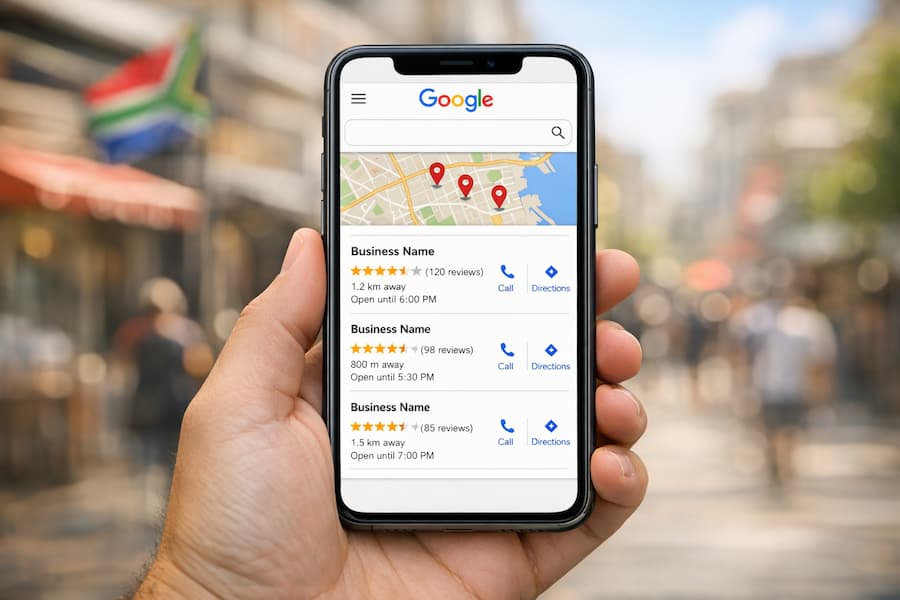
The mistake is twofold. First, most businesses have no systematic process for generating reviews. They rely entirely on customers spontaneously leaving reviews, which produces a trickle of feedback that is often skewed toward negative experiences (dissatisfied customers are more motivated to leave reviews than satisfied ones). Second, even businesses that do receive reviews frequently fail to respond to them — particularly negative reviews, which is the worst possible approach.
Google has explicitly confirmed that responding to reviews is a positive ranking signal. When a business responds to reviews, Google interprets this as an engaged, customer-focused business — exactly the type of business Google wants to surface in local results. Responding to positive reviews reinforces the relationship and encourages future reviews. Responding to negative reviews demonstrates professionalism and often neutralises the impact of the negative feedback in the eyes of potential customers reading those reviews.
In South Africa, WhatsApp is the most effective channel for review requests. After completing a service or sale, send a direct WhatsApp message with your Google review link. The friction is minimal — the customer taps the link, rates, writes a sentence or two, and submits. Automated WhatsApp sequences triggered 7 to 14 days after service delivery consistently generate 3 to 5 times more reviews than passive approaches.
Review Generation Best Practices
- Ask at the moment of satisfaction — Immediately after a successful job completion, a positive interaction, or a thank-you from the customer.
- Make it frictionless — Share a direct Google review link via WhatsApp or SMS. Do not ask customers to search for your business on Google and find the review section themselves.
- Respond to every review — Positive, negative, and neutral. Thank positive reviewers by name. Address negative reviews professionally with empathy and an offer to resolve the issue.
- Never incentivise reviews — Offering discounts, gifts, or rewards in exchange for reviews violates Google's guidelines and can result in review removal or profile suspension.
- Aim for consistency — A steady flow of 2-4 reviews per month signals ongoing business activity and customer satisfaction. A burst of 20 reviews in one week followed by months of silence looks unnatural.
Mistake 4: Wrong or Missing Business Categories
Business categories in your Google Business Profile are the single most powerful relevance signal in local search. They tell Google exactly what your business does and which search queries your listing should appear for. Getting categories wrong — or leaving secondary categories empty — is like telling Google to ignore you for the very searches your customers are performing.
The primary category mistake we see most frequently is selecting a category that is too broad. A dental practice that selects "Healthcare" instead of "Dentist" has removed itself from the specific dental search queries that drive patient bookings. A restaurant that selects "Food" instead of "Indian Restaurant" or "Sushi Restaurant" loses relevance for the cuisine-specific searches that diners actually perform. Google offers hundreds of specific categories — always select the most specific option that accurately describes your core business.
The secondary category mistake is equally damaging. Google allows up to nine secondary categories, and each one expands the range of queries your listing can appear for. A plumbing business that only selects "Plumber" as its primary category and adds no secondary categories is missing visibility for related searches like "water heater repair," "drain cleaning service," or "bathroom remodelling." Adding secondary categories like "Water Heater Repair Service," "Drain Cleaning Service," and "Bathroom Remodeler" makes the listing eligible for all of those additional query types.
Research your competitors' categories before selecting your own. Tools like GMB Everywhere (a Chrome extension) allow you to see exactly which categories your top-ranked local competitors are using. If a competitor ranking above you has a secondary category that you lack, adding that category is often one of the fastest ranking improvements available.
Mistake 5: No Local Content Strategy
Many South African businesses invest in generic SEO content — blog posts about industry topics, service descriptions, and company news — without any local content strategy. They write about "plumbing tips" instead of "common plumbing problems in Johannesburg homes." They create a single "Services" page instead of individual pages for each service area they cover. They ignore the geographic dimension of search intent entirely, and their local rankings suffer as a direct result.

Local content strategy means creating website content that explicitly connects your services to the geographic areas you serve. This serves two purposes: it provides Google with clear on-page signals about your service areas and relevance to location-specific queries, and it provides potential customers with content that directly addresses their local context — which increases engagement, time on site, and conversion rates.
Types of Local Content That Drive Rankings
- Location-specific service pages — Create individual pages for each major suburb or city you serve. "Electrician in Sandton," "Electrician in Randburg," "Electrician in Fourways" — each page should have unique content addressing the specific needs, common issues, and context of that area. Do not simply duplicate content and swap the location name.
- Local case studies and project showcases — Document completed projects with specific location context. "Commercial HVAC Installation at Menlyn Park Shopping Centre" is far more powerful for local SEO than "Commercial HVAC Installation Project."
- Area guides and neighbourhood content — Content that establishes your authority within a specific area. A real estate agent creating neighbourhood guides for Umhlanga, Ballito, and Hillcrest demonstrates deep local knowledge while targeting valuable local search terms.
- Local event and news content — Blog posts tied to local events, developments, or news relevant to your industry. A roofing company writing about storm damage repair after a Gauteng hailstorm addresses timely, high-intent local search queries.
- FAQ content with local context — "How much does a geyser replacement cost in Cape Town?" targets a specific, high-intent local query with transactional potential.
The key principle is specificity. Generic content competes with every business in your industry nationwide. Locally-specific content competes only with businesses in your geographic area — a dramatically smaller and more winnable competitive field. For a deeper dive into structuring your entire local SEO approach, read our Complete 2026 Local SEO Ranking Guide.
Local Content Framework: For every core service you offer, create a dedicated page for each of your top 3-5 service areas. A business offering 4 services across 5 areas creates 20 locally-targeted pages — each one a new opportunity to rank for a specific "service + location" query. Ensure each page has genuinely unique content (minimum 500 words) and is not a template with swapped location names.
Mistake 6: Duplicate or Conflicting Business Listings
Duplicate business listings are one of the most insidious local search SEO mistakes because they actively split your ranking signals. When your business has two or more Google Business Profile listings, or multiple listings across directories with conflicting information, Google cannot consolidate your reviews, citations, and engagement signals into a single authoritative entity. The result is that your ranking power is divided between multiple listings, and none of them rank as well as a single, consolidated listing would.
Duplicates arise from several common scenarios. A previous business owner or employee may have created a listing years ago that was never claimed or updated. A marketing agency may have created a new listing without realising one already existed. The business may have changed addresses or names, and the old listing was never removed. In some cases, Google itself creates duplicate listings based on data it aggregates from third-party sources — and these auto-generated listings often contain inaccurate information.
In South Africa, we frequently see duplicates caused by business relocations. A business moves from Sandton to Rosebank, creates a new GBP listing for the new address, but never closes or merges the old Sandton listing. Both listings remain active, the old one accumulates confused customer visits and negative reviews from people who visit the old address, and Google's confidence in both listings drops. The business ends up ranking poorly for both Sandton and Rosebank searches — the worst possible outcome.
How to Find and Fix Duplicate Listings
- Search Google Maps for your business name — Look for multiple pins or listings appearing for your business. Search variations of your business name as well.
- Search your phone number and address — Enter your phone number and address into Google to find all listings associated with those details.
- Use duplicate detection tools — BrightLocal, Moz Local, and Semrush all have duplicate listing detection features that scan across major directories and Google Maps.
- Report duplicates to Google — Use the "Suggest an edit" feature on Google Maps to mark duplicate listings as "Place has permanently closed" or "Duplicate." For listings you own, merge them through GBP support.
- Consolidate directory listings — Contact directories directly to remove or merge duplicate entries. Ensure only one listing per directory remains, with your correct master NAP data.
Mistake 7: Neglecting Mobile Optimization for Local Search
Over 60% of local searches in South Africa happen on mobile devices, and that percentage is growing every year. When someone searches "restaurant near me" or "emergency electrician Pretoria," they are overwhelmingly doing so on a smartphone — often while standing on a pavement, sitting in a car, or dealing with an urgent need. If your website delivers a poor mobile experience, you are losing the majority of your local search traffic at the point of highest intent.
Mobile optimisation for local search goes beyond responsive design. Yes, your site must render correctly on mobile screens — but that is the bare minimum. True mobile optimisation for local search means: fast page load speeds on mobile networks (under 3 seconds on 4G), click-to-call phone numbers that work on mobile, easy-to-tap buttons and navigation elements, visible address and directions integration, and a streamlined conversion path that accounts for the mobile user's context and urgency.
Google's mobile-first indexing means that Google evaluates the mobile version of your website first when determining rankings. If your desktop site is excellent but your mobile site is slow, cluttered, or difficult to navigate, your local rankings will reflect the mobile experience — not the desktop one. This is particularly critical in South Africa, where many users access the internet primarily through mobile devices and may be on variable-speed mobile data connections.
Mobile Speed Warning: Google's research shows that 53% of mobile visitors abandon a site that takes longer than 3 seconds to load. For local searches with high intent — emergency services, nearby dining, immediate service needs — that threshold is even lower. If your site loads in 5+ seconds on mobile, you are losing more than half your local search traffic before they even see your content. Run your site through Google PageSpeed Insights and prioritise mobile performance. For a detailed guide on improving load times, see our Page Speed & SEO guide.
Mobile Optimization Checklist for Local Search
- Test load speed on mobile — Use Google PageSpeed Insights with the "Mobile" tab selected. Target a performance score of 90+ and a Largest Contentful Paint under 2.5 seconds.
- Implement click-to-call — Your phone number should be a tappable link (using
tel:href) on every page, ideally in the header and footer. - Add a Google Maps embed — Include an interactive Google Maps embed on your contact page so mobile users can get directions with a single tap.
- Simplify mobile navigation — Large, easily tappable menu items. Prominently visible contact and call-to-action buttons. Remove any elements that require hover interactions (which do not exist on touchscreens).
- Optimise images for mobile — Use WebP format, lazy loading, and responsive image sizing. Images are the most common cause of slow mobile load times.
- Test on real devices — Emulators do not capture real-world performance. Test your site on mid-range Android devices common in South Africa (Samsung Galaxy A series, Huawei P series) on a standard LTE connection.
How to Fix These Mistakes (Action Plan)
Identifying the mistakes is the first step. Fixing them systematically is what actually moves your rankings. Below is a prioritised action plan that addresses all seven local search SEO mistakes in the order that will produce the fastest ranking improvements.
Week 1-2: Foundation Fixes
- Create your master NAP document — Standardise your business name, full address, and phone number. This is the reference for everything else.
- Claim and complete your Google Business Profile — If unclaimed, claim it immediately. If incomplete, fill every section: description, categories (primary + all relevant secondaries), services, attributes, hours (including special hours), and photos (minimum 10).
- Fix your primary category — Confirm you have selected the most specific primary category. Research competitor categories and add all relevant secondary categories.
- Scan for and resolve duplicate listings — Search Google Maps, search your phone number, and use a duplicate detection tool. Report, merge, or remove all duplicates.
Week 3-4: Citation and Review Cleanup
- Audit and correct all citations — Use BrightLocal or Moz Local to scan your citation landscape. Update every listing to match your master NAP. Claim unclaimed listings on major South African directories (Yellow Pages SA, Brabys, Hotfrog, Cylex, Yelp SA).
- Implement a review generation system — Create your direct Google review link. Set up a WhatsApp or SMS template for post-service review requests. Begin asking every satisfied customer for a review.
- Respond to all existing reviews — Go through every review on your GBP — positive, negative, and neutral — and write a personalised response to each one.
Month 2-3: Content and Mobile
- Create location-specific service pages — Start with your top 3 service areas and your top 3 services. Create a unique page for each combination with genuinely original content (minimum 500 words per page).
- Begin weekly GBP posting — Create a content calendar for Google Posts. Mix service highlights, offers, tips, and customer success stories. Post at minimum once per week.
- Run a mobile performance audit — Test your site on Google PageSpeed Insights (mobile). Fix the top 3 performance issues identified. Target sub-3-second load times on mobile.
- Implement click-to-call and maps integration — Ensure your phone number is tappable on mobile across all pages. Add a Google Maps embed to your contact page.
Priority Rule: If you can only do three things from this entire action plan, do these: (1) claim and fully complete your Google Business Profile with the correct primary category, (2) fix your NAP across your top 10 citation sources, and (3) start generating reviews via WhatsApp. These three actions address the highest-impact ranking factors and will produce visible improvements within 4-8 weeks for most South African businesses.
If you'd rather have the whole cleanup handled for you, our local SEO services cover GBP optimisation, citation correction, review generation and location pages — with weekly rank tracking so you can see the mistakes being fixed.
Frequently Asked Questions
The most common local search SEO mistake is NAP inconsistency — having different versions of your business name, address, or phone number across directories, citations, and your website. Even minor variations like "Rd" versus "Road" or listing an old phone number on one directory can confuse Google's trust algorithms and suppress your local rankings. A full NAP audit across all citation sources is the first step in any local SEO fix.
The clearest signs of local SEO mistakes are: your business does not appear in the local 3-pack for your primary services, your Google Business Profile shows incorrect or outdated information, you have fewer than 10 Google reviews, your website does not rank for "service + city" keywords, or you see duplicate listings for your business on Google Maps. Running a local SEO audit using tools like BrightLocal, Moz Local, or Semrush's listing management tool will reveal specific issues across your citations, GBP, and on-page local signals.
Most local SEO fixes take 4 to 12 weeks to show measurable ranking improvements. NAP corrections across citation sources typically take 2 to 6 weeks to propagate and be re-crawled by Google. Google Business Profile changes can impact rankings within days for minor updates, or 2 to 4 weeks for category changes and major profile edits. Review velocity improvements take the longest — building a consistent flow of new reviews is a 3 to 6 month process before the ranking impact compounds significantly.
Yes, duplicate business listings are one of the most damaging local SEO mistakes. When Google finds multiple listings for the same business, it splits your ranking signals — reviews, citations, and engagement data are divided between listings instead of consolidated on one authoritative profile. Duplicates also confuse customers who may find outdated information on the secondary listing. Google may also penalise or suppress all listings if it suspects deliberate manipulation. Identifying and merging or removing duplicates should be a priority in any local SEO cleanup.
Absolutely. Responding to every negative review is critical for both local SEO and customer trust. Google has confirmed that responding to reviews signals that you value customer feedback, which positively influences your local ranking. From a customer perspective, 89% of consumers read business responses to reviews. A professional, empathetic response to a negative review often impresses potential customers more than the negative review deters them. Never respond defensively or argue — acknowledge the concern, apologise where appropriate, and offer to resolve the issue offline.
About NexusSEO
We're a premium SEO agency based in South Africa with 18+ years of experience. We've helped 450+ businesses rank on Google and generate millions in organic revenue. Specialising in local SEO, eCommerce, and professional services SEO across KwaZulu-Natal, Gauteng, and the Western Cape.
Learn More About UsRelated Articles
Local SEO
How to Rank Local SEO: Complete 2026 Guide
The full local SEO strategy: GBP, citations, reviews, and local link building.
Local SEO
The Complete Guide to Google Business Profile Optimization
Master every element of GBP for top local pack placement.
Technical SEO
Page Speed & SEO: Why Your Site is Losing Rankings
How slow load times destroy your search visibility and what to fix first.
Fix Your Local SEO Today
Get a free local SEO audit. We'll identify every mistake hurting your local rankings and give you a clear fix plan.
GET FREE LOCAL AUDITGet Your Free SEO Audit
Submit your details and we'll analyse your website's SEO performance within 24 hours.